

Working Principles of Stone Cutting Machines

Stone cutting machines are essential processing equipment in the global stone industry. According to different cutting modes, tool configurations and automation levels, they are categorized into four mainstream types: diamond blade cutters, diamond wire saws, abrasive waterjet cutters, and CNC stone machining centers. Despite different structural designs and operating modes, all stone cutting equipment functions on the same basic principle: breaking the physical structure and hardness of stone to achieve splitting, trimming and shaping. This document systematically introduces the composition, working mechanism and practical features of each type of stone cutting machine.
1. Diamond Blade Cutting Machine: Most Common Stone Processing Equipment

Diamond blade cutting machines cover handheld portable cutters, fixed bridge saws and multi-blade block cutters. They are widely applicable to granite, marble, engineered stone, sintered stone and most common stone materials. The equipment relies on mechanical transmission and abrasive grinding to complete efficient stone cutting.
1.1 Structural Composition
The machine consists of six core systems: power unit (electric motor or hydraulic motor), transmission unit (main shaft, belts and gears), cutting execution unit (diamond saw blade), support and clamping unit (frame, workbench and fixtures), circulating cooling system and electric control system. The diamond saw blade is the key consumable component, made of a high-strength steel substrate and welded or sintered diamond segments. The steel substrate ensures stable high-speed operation, while diamond segments contain high-hardness diamond particles mixed with metal bonding materials. As the hardest industrial material, diamond provides the abrasive force required for stone cutting.
1.2 Working Principle
Power Transmission: After startup, the motor or hydraulic device outputs power to drive the main shaft, enabling the diamond blade to rotate at a high and stable speed. Operators adjust the rotational speed based on stone hardness and cutting thickness - lower speed for hard granite and higher speed for relatively soft marble to balance cutting efficiency and blade wear.
Cutting Process: High-speed rotating diamond particles continuously grind, impact and peel off mineral particles such as quartz and feldspar on the stone surface. The sharp edges of diamond grains destroy the internal crystal structure of stone, turning solid stone into fine dust and debris. Continuous horizontal or vertical feeding of the blade completes overall stone cutting.
Self-Wear Compensation: During long-term operation, surface diamond particles gradually wear down and fall off. The metal bonding layer wears synchronously, exposing new diamond particles continuously. This self-renewing structure maintains stable cutting performance and extends the overall service life of the saw blade.
Cooling and Protection: High-speed friction during cutting generates massive heat, which easily causes blade deformation, accelerated abrasion, and stone chipping or cracking. The matching cooling system continuously sprays circulating water on the cutting area to lower operating temperature, wash away residual stone debris, and guarantee consistent cutting accuracy and surface finish.
1.3 Features of Typical Models
Handheld diamond cutters feature flexible blade movement with fixed stone placement, suitable for on-site construction and small-batch customized cutting. Bridge saws adopt adjustable beam lifting and workbench positioning, delivering a cutting accuracy of ±0.1 mm, ideal for standardized mass processing of large stone slabs. Multi-blade block cutters are equipped with multiple parallel saw blades, which can cut whole quarry blocks into uniform finished slabs in one single pass, greatly improving the processing efficiency of raw stone materials.
2. Diamond Wire Saw: Professional Equipment for Quarry Mining and Large-Scale Cutting

Diamond wire saws are primarily used for quarry block mining, large-size stone splitting and special-shaped stone processing. Compared with traditional blade cutters, they offer superior flexibility and support omnidirectional and curve cutting, making them the mainstream equipment for large-scale stone mining and irregular forming.
2.1 Structural Composition
The main components include diamond wire rope, driving wheels, guide wheels, automatic tensioning device, power system, control system and cooling system. The diamond wire rope is the core cutting component. It adopts high-tensile steel wire as the core, with uniformly arranged diamond beads fixed on the surface. Each diamond bead is composed of high-hardness diamond particles and wear-resistant metal binder, ensuring strong cutting capability and long service life.
2.2 Working Principle
Wire Tensioning and Positioning: Before operation, the diamond wire rope is wound around the driving and guide wheels and tightly wrapped around the target stone. The tensioning device precisely adjusts wire tension to avoid slackness, vibration and slipping during high-speed circulating movement. Tension parameters are optimized according to stone hardness and actual cutting speed.
Circulating Grinding Cutting: The power system drives the driving wheels to rotate, enabling the diamond wire rope to run in a closed loop. Unlike the surface contact cutting of saw blades, wire saws adopt line-contact grinding. Continuous movement of diamond beads polishes and cuts the stone, forming narrow, smooth and neat cutting seams.
Steady Cutting Advancement: The control system adjusts the guide wheel position or equipment moving speed to push the wire saw forward along the preset cutting path. Cooling water is continuously sprayed on the cutting area to reduce friction temperature, remove cutting debris and lower overall resistance.
Application Advantages: The flexible cutting mode supports straight, curved and irregular special-shaped cutting. It produces slight impact and extrusion on stone materials, effectively avoiding cracking, edge collapsing and internal damage. It is widely used in granite and marble quarry mining, large stone sculpture shaping and ultra-large slab splitting.
3. Abrasive Waterjet Cutting Machine: High-Precision and Zero-Thermal-Damage Processing Equipment
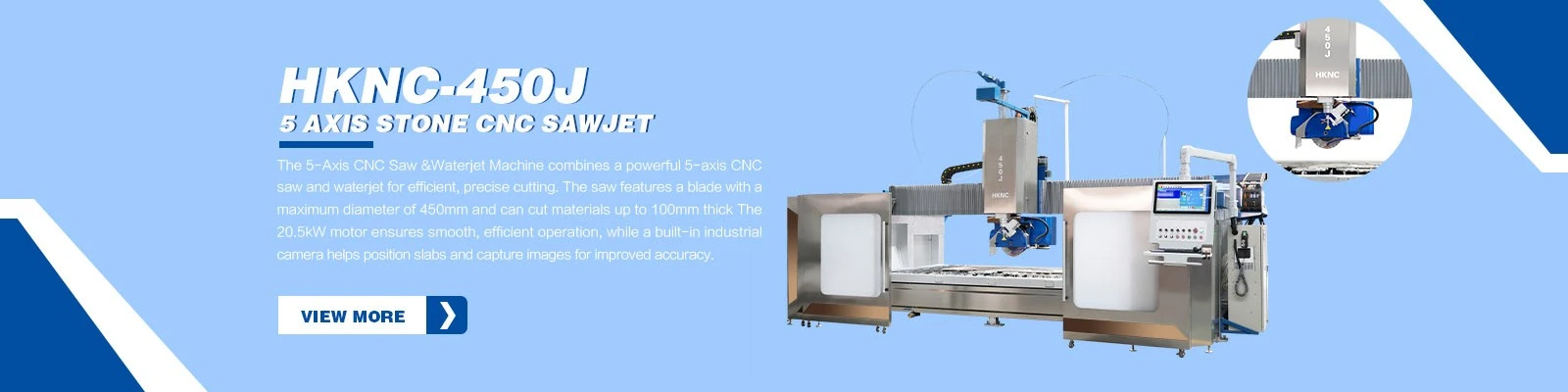
Abrasive waterjet cutters, commonly known as waterjet machines, complete stone cutting by using high-pressure mixed water and abrasives. They are the preferred equipment for high-precision and complex special-shaped stone processing. With zero thermal damage and dust-free operation, they are especially suitable for heat-sensitive and fragile stone such as jade, agate and soft marble.
3.1 Structural Composition
The equipment consists of a high-pressure water pump, automatic abrasive feeding system, precision cutting nozzle, processing workbench, numerical control system and water circulation filtration system. The high-pressure water pump pressurizes conventional water up to 600 MPa to form high-speed kinetic water flow. The abrasive system stably conveys garnet or emery abrasives. The tiny-diameter nozzle concentrates the mixed jet to form high-density cutting impact force.
3.2 Working Principle
High-Pressure Water Generation: The professional water pump performs multi-stage supercharging on inlet water to produce ultra-high-pressure and high-speed water jet with powerful kinetic energy.
Automatic Abrasive Mixing: High-speed water flow forms instantaneous negative pressure inside the nozzle, which automatically sucks in and fully mixes with abrasives. The formed water-abrasive mixed jet significantly improves cutting efficiency, especially for high-hardness stone materials.
Jet Impact Cutting: The mixed jet sprays out at supersonic speed, continuously impacting, stripping and breaking the internal crystal structure of stone to complete cutting. As the cutting medium is fluid water and abrasives, the whole process generates no high temperature, causing no thermal deformation or surface burn on stone, and produces no processing dust.
High-Precision Numerical Control: The control system accurately adjusts nozzle moving trajectory, water pressure and abrasive feeding volume. The cutting accuracy can reach ±0.01 mm, fully meeting the processing requirements of special-shaped countertops, artistic stone carvings and complex pattern cutting.
4. CNC Stone Machining Center: Intelligent Integrated Processing Equipment
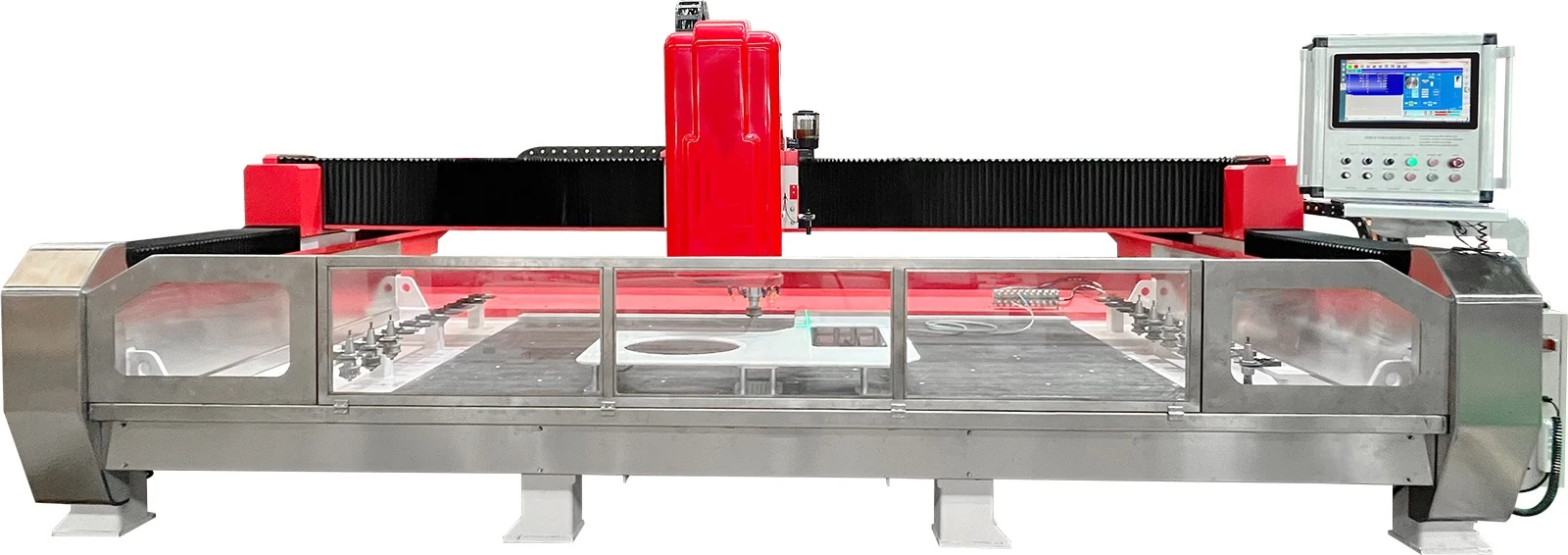
CNC stone machining centers integrate multiple functions including cutting, edge trimming, carving, drilling and grooving. Combining mechanical transmission, numerical control technology and automatic servo driving systems, they realize full-automatic, high-precision and one-stop processing for high-end customized stone products.
4.1 Structural Composition
The equipment is composed of a rigid heavy-duty machine frame, CNC control system, high-precision servo drive system, multi-functional processing tools (diamond blades, carving cutters, waterjet nozzles), fixed workbench, automatic loading and unloading device, and cooling and dust removal system. The CNC system serves as the core control unit for receiving processing data and planning cutting paths. The servo drive system precisely controls the moving position, speed and feeding depth of tools and workbenches.
4.2 Working Principle
Digital Programming: Operators input processing parameters such as cutting path, running speed and feeding depth into the CNC system according to design drawings. The system automatically generates accurate processing trajectories and operation commands. For complex special-shaped workpieces, standard CAD/CAM files can be imported directly to realize fast one-click programming.
Workpiece Positioning and Fixing: Stone workpieces are placed on the workbench and firmly fixed by automatic pneumatic or hydraulic fixtures. The CNC system completes precise datum positioning through visual recognition or manual calibration to ensure overall processing accuracy. High-end models are equipped with automatic loading and unloading functions to improve continuous production efficiency.
Automatic Cutting and Forming: Driven by high-precision servo motors, processing tools move strictly along the preset trajectory. The system dynamically adjusts operating parameters in real time to complete integrated processing including cutting, carving, edging and drilling. It supports real-time monitoring of equipment status, automatically calibrates processing deviations and gives early warnings of tool wear to ensure stable and consistent processing quality.
Auxiliary System Operation: The circulating cooling system continuously supplies cooling liquid to reduce tool operating temperature and reduce abrasion. The matched dust removal system collects stone debris and floating dust to keep the workshop environment clean. After processing is completed, the automatic handling system unloads finished products to finish the whole production procedure.
5. Performance Comparison and Application Scenarios
|
Equipment Type |
Core Working Principle |
Cutting Accuracy |
Application Scenarios |
|
Diamond Blade Cutting Machine |
High-speed rotating diamond particles grind and impact stone to realize material separation |
±0.05mm ~ ±0.1mm |
Mass slab production, on-site construction cutting, preliminary splitting of quarry raw blocks |
|
Diamond Wire Saw |
Cyclically running diamond beads conduct line-contact grinding to cut stone |
±0.1mm ~ ±0.2mm |
Quarry block mining, ultra-large stone splitting, irregular special-shaped cutting |
|
Waterjet Cutting Machine |
High-pressure water-abrasive mixed jet impacts and peels off stone structure |
±0.01mm ~ ±0.05mm |
High-precision special-shaped processing, fragile and heat-sensitive stone cutting, environmentally friendly production |
|
CNC Stone Machining Center |
CNC system controls multi-functional tools to complete full-process automatic processing |
Within ±0.01mm |
High-end customized stone products, complex artistic shaping, intelligent mass production |
In conclusion, all stone cutting machines rely on two core cutting mechanisms: abrasive grinding and high-pressure impact stripping. Different types of equipment adopt targeted structural and technological designs to adapt to diverse processing requirements. In actual industrial production, equipment selection should be based on stone material properties, precision standards and production scale to balance processing efficiency and product quality. In addition, regular inspection of wearing parts, daily maintenance of cooling and transmission systems, and standardized operation are essential to ensure stable equipment operation and extend service life.
