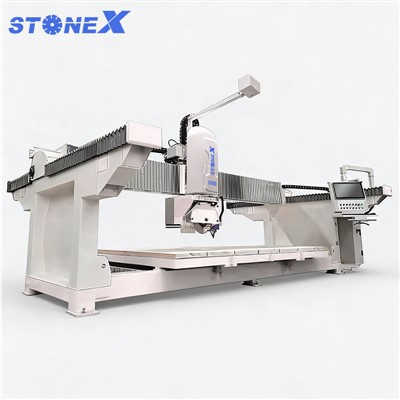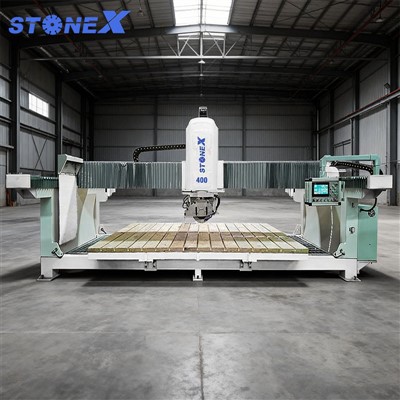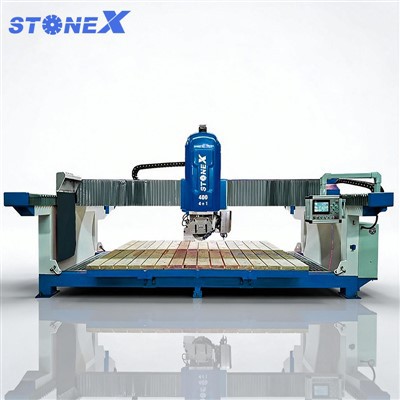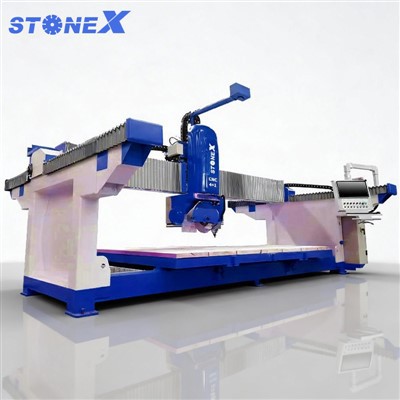

The structural design of a bridge saw directly affects its cutting accuracy and stability. The main components include the frame, bridge, saw blade, motor, guide rails, worktable, and control system.
Frame: Provides overall support, ensuring stability during bridge saw cutting and preventing cutting errors caused by vibration. Large bridge saw frames typically use welded steel structures, offering high rigidity and durability.
Bridge: Spans above the worktable, supporting the saw blade and motor, and can move along the X-axis or Y-axis. The rigidity and precision of the bridge directly affect the straightness of the cutting line.
Saw Blade and Motor: The saw blade is usually made of diamond or alloy materials, possessing high hardness and wear resistance; the motor provides the rotational power for the saw blade, and high-power motors can cut thick plates.
Guide Rails and Sliding System: The guide rails ensure smooth movement of the bridge and saw blade, achieving precise cutting; high-precision rollers or linear guide rails reduce friction and increase lifespan.
Worktable: Used to fix the workpiece, with adjustable height and angle. Some bridge saw worktables are equipped with hydraulic lifting systems for rapid material positioning and clamping.
Control system: Modern bridge saws use a CNC system, which allows operators to input cutting dimensions, paths and angles via touch screen or computer to achieve automated cutting, while also providing safety protection and fault alarm functions.