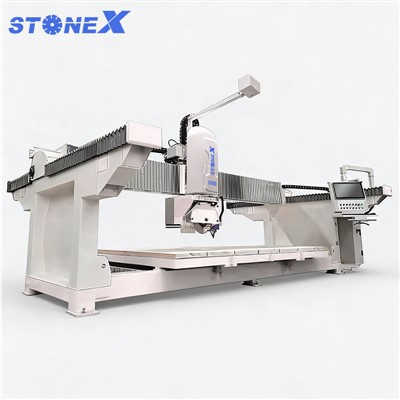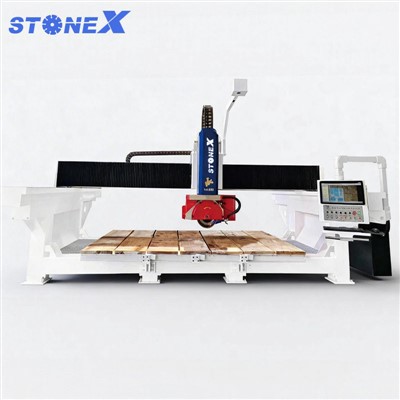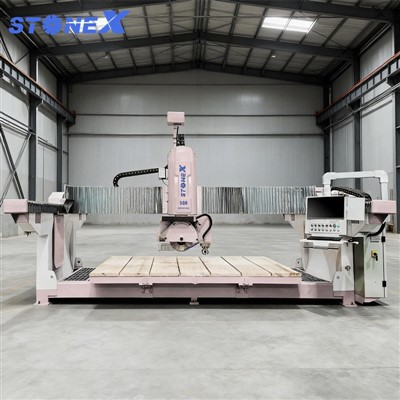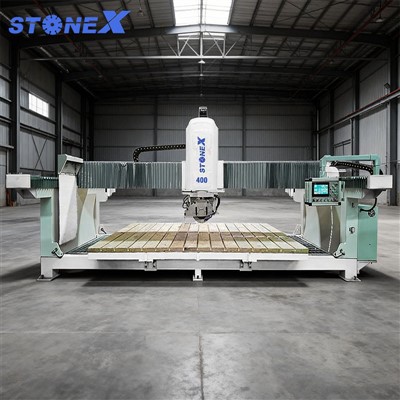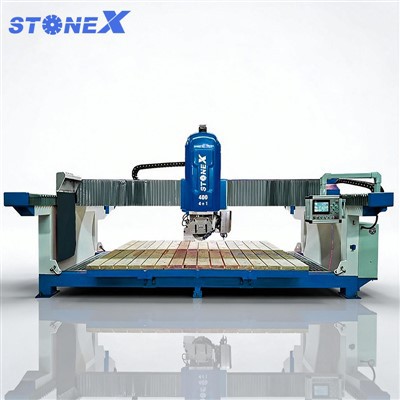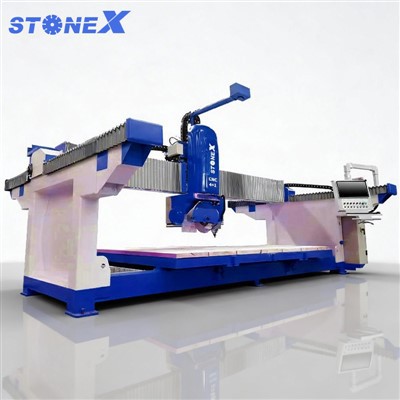

The structure of a bridge saw for stone cutting is fundamental to its high-precision cutting capabilities. Its core components include the frame, bridge, saw blade, motor, guide rails, worktable, and control system.
Frame: The frame is the foundation of the bridge saw, typically constructed of welded steel, providing high rigidity and stability. During cutting, the frame must withstand the vibrations generated by the rotating saw blade, ensuring a smooth cutting process. The stability of the frame directly affects cutting accuracy and is one of the core design parameters of the bridge saw.
Bridge: The bridge spans the worktable, supporting the saw blade and motor, and moves along the X-axis. The precision and rigidity of the bridge determine the stability of the saw blade's movement and the straightness of the cut. High-end bridge saws typically employ precision guide rails and roller systems to reduce friction and improve stability.
Saw Blade and Motor: The saw blade is often made of diamond composite material, offering high hardness and wear resistance, suitable for cutting hard stones such as marble and granite. The motor provides the rotational power for the saw blade; high-power motors can handle thick slabs and high-density stone. Some bridge saws are equipped with a speed control system, allowing adjustment of the saw blade speed according to the material's hardness.
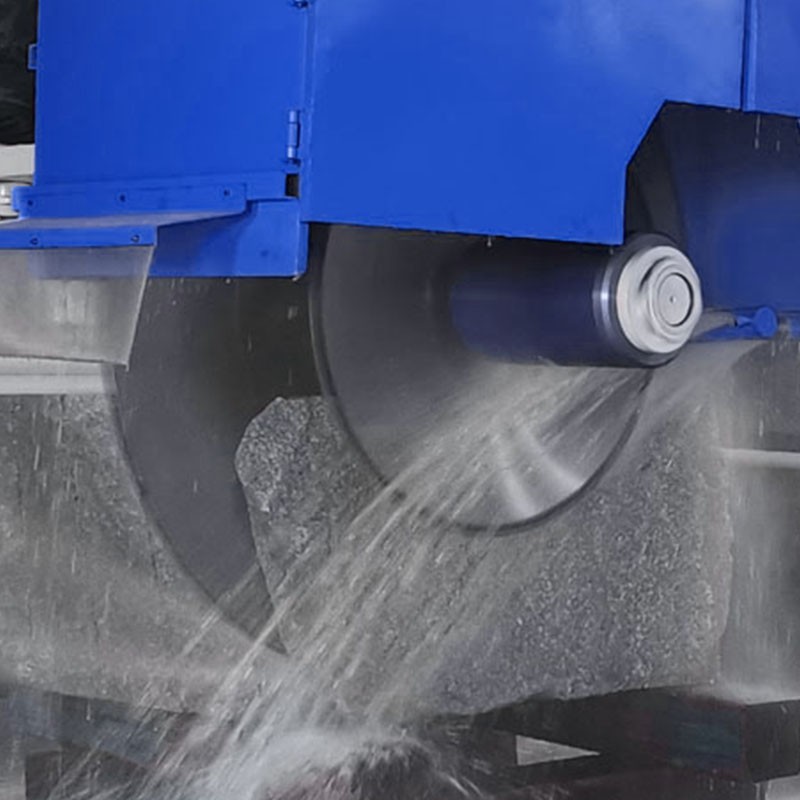
Saw Blade and Motor: Guide rails and sliding system: Guide rails ensure smooth bridge movement and support precise positioning of the saw blade along the X and Y axes. Precision slide rails, rollers, and lubrication systems reduce friction and extend equipment life.
Worktable: The worktable is used to hold the workpiece and can support large-sized stones. Some bridge saws have adjustable worktable height and angle, and with the help of a hydraulic lifting device, they can achieve quick clamping and precise positioning.
Control system: Modern bridge saws use a CNC system. The operator can input the cutting dimensions, angle, and path, and the system can automatically complete the cutting task. Advanced systems also support multi-segment cutting, beveling, curve cutting, and batch production, significantly improving processing efficiency and accuracy.